人生就是不停地在做选择,抓起一些,就得放下一些。豁达的人经常问自己,我得到了什么,而不是我失去了什么?选择了一条路,自然会错过另一条路上的风景,与其眺望远处,不如珍惜眼前,每个地方都会春暖花开。
—— 杨坚华 《遇见德国》
这两天在读《遇见德国》,本来是为了猎取奇观的,看看有趣的文化冲突。但是读到以上这一段话的时候,却引起了我深深的共鸣。有些时候选择很多,但是我们需要对自己有足够的了解才能选择一条最适合自己的,而且迈出那一步也是相当需要勇气和技巧,所谓万事开头难。
人生就是不停地在做选择,抓起一些,就得放下一些。豁达的人经常问自己,我得到了什么,而不是我失去了什么?选择了一条路,自然会错过另一条路上的风景,与其眺望远处,不如珍惜眼前,每个地方都会春暖花开。
—— 杨坚华 《遇见德国》
这两天在读《遇见德国》,本来是为了猎取奇观的,看看有趣的文化冲突。但是读到以上这一段话的时候,却引起了我深深的共鸣。有些时候选择很多,但是我们需要对自己有足够的了解才能选择一条最适合自己的,而且迈出那一步也是相当需要勇气和技巧,所谓万事开头难。
The topic of this weekend is watching movies. For each movie, I wrote a one-setence comment.
CRIMSON TIDE: Resultant justice is on the basis of procedural justice, and there is not a conflict between them.

فروشنده: Life is like a play and good people is always touching you.
PATRIOTS DAY: Evils encourage us to care and love.

THE JUNGLE BOOK: Know who we are and act as who we are.

PASSENGERS: Human is a species of society.
It’s spring. Let’s go out embracing the nature!

TITLE: Deep Image Matting
AUTHOR: Ning Xu, Brian Price, Scott Cohen, Thomas Huang
ASSOCIATION: Beckman Institute for Advanced Science and Technology, University of Illinois at Urbana-Champaign, Adobe Research
FROM: arXiv:1703.03872
The proposed deep model has two parts.
The method is illustrated in the following figure.
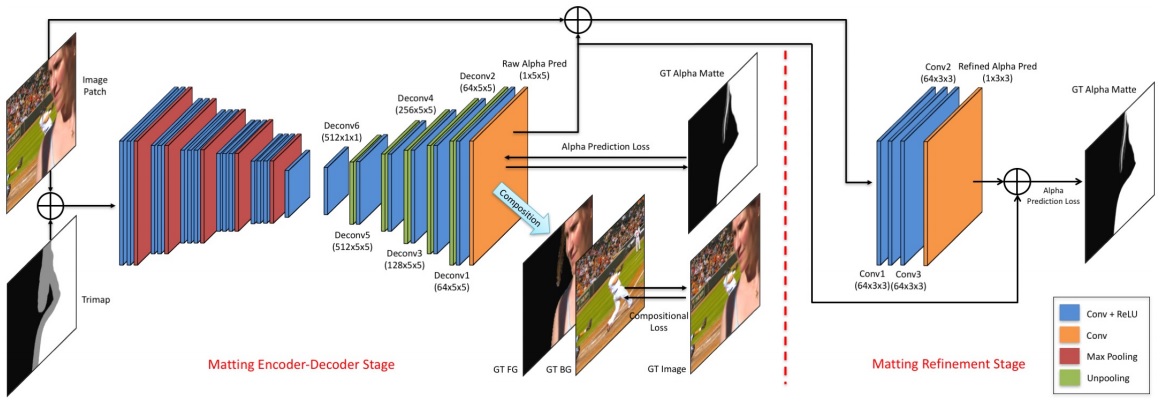
The first network leverages two losses. One is alpha-prediction loss and the other one is compositional loss.
Alpha-prediction loss is the absolute difference between the ground truth alpha values and the predicted alpha values at each pixel, which defines as
$$\mathcal{L}{\alpha}^{i} = \sqrt{(\alpha{p}^{i} - \alpha_{g}^{i})^{2}+\epsilon^2}, \alpha_{p}^{i}, \alpha_{g} \in [0,1]$$
where $\alpha_{p}^{i}$ is the output of the prediction layer at pixel $i$ and $\alpha_{g}^{i}$ is the ground truth alpha value at pixel $i$. $\epsilon$ is a small value which is equal to $10^{-1}$ and is used to ensure differentiable property.
Compositional loss the absolute difference between the ground truth RGB colors and the predicted RGB colors composited by the ground truth foreground, the ground truth background and the predicted alpha mattes. The loss is defined as
$$\mathcal{L}{c}^{i} = \sqrt{(c{p}^{i} - c_{g}^{i})^{2}+\epsilon^2}$$
where $c$ denotes the RGB channel, $p$ denotes the image composited by the predicted alpha, and $g$ denotes the image composited by the ground truth alpha.
Since only the alpha values inside the unknown regions of trimaps need to be inferred, therefore weights are set on the two types of losses according to the pixel locations, which can help the network pay more attention on the important areas. Specifically, $w_{i} = 1$ if pixel $i$ is inside the unknown region of the trimap while $w_{i} = 0$ otherwise.
The input to the second stage of our network is the concatenation of an image patch and its alpha prediction from the first stage, resulting in a 4-channel input. This part is trained after the first part is converged. After the refinement part is also converged, finally fine-tune the the whole network together. Only the alpha prediction loss is used.
TITLE: A Pursuit of Temporal Accuracy in General Activity Detection
AUTHOR: Yuanjun Xiong, Yue Zhao, Limin Wang, Dahua Lin, Xiaoou Tang
ASSOCIATION: The Chinese University of Hong Kong, ETH
FROM: arXiv:1703.02716
The proposed action detection framework starts with evaluating the actionness of the snippets of the video. A set of temporal action proposals (in orange color) are generated with temporal actionness grouping (TAG). The proposals are evaluated against the cascaded classifiers to verify their relevance and completeness. Only proposals being complete instances are produced by the framework. Non-complete proposals and background proposals are rejected by a cascaded classification pipeline. The framework is illustrated in the following figure.
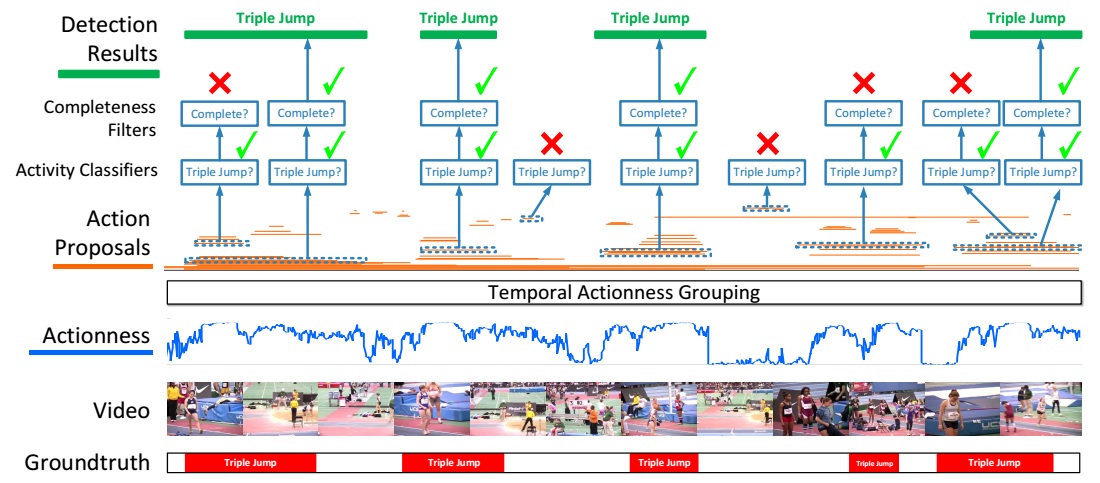
The temporal region proposals are generated with a bottom-up procedure, which consists of three steps: extract snippets, evaluate snippet-wise actionness, and finally group them into region proposals.
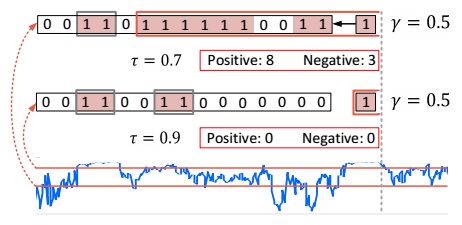
Note that this scheme is controlled by two design parameters: the actionness threshold and the tolerance threshold. The final proposal set is the union of those derived from individual combination of the two values. This scheme is called Temporal Actionness Grouping, illustrated in the above figure, which has several advantages:
this is accomplished by a cascaded pipeline with two steps: activity classification and completeness filtering.
Activity Classification
A classifier is trained based on TSN. During training, region proposals that overlap with a ground-truth instance with an IOU above 0.7 will be used as positive samples. A proposal is considered as a negative sample only when less than 5% of its time span overlaps with any annotated instances. Only the proposals classified as non-background classes will be retained for completeness filtering. The probability from the activity classifier is denoted as $P_{a}$.
Completeness Filtering
To evaluate the completeness, a simple feature representation is extracted and used to train class-specific SVMs. The feature comprises three parts: (1) A temporal pyramid of two levels. The first level pools the snippet scores within the proposed region. The second level split the segment into two parts and pool the snippet scores inside each part. (2) The average classification scores of two short periods – the ones before and after the proposed region. The method is illustrated in the following figure.

The output of the SVMs for one class is denoted as $S_{c}$.
Then final detection confidence for each proposal is
$$ S_{Det} = P_{a} \times S_{c} $$
Sunday was really sunny! Beautiful breakfast, beautiful day!

I said ten days ago that maybe I could make cakes in the futue. Then today I made this dream true. This is the first time that I made a cake, which seems to be not that hard and it brought me much sense of pleasure in this weekend.

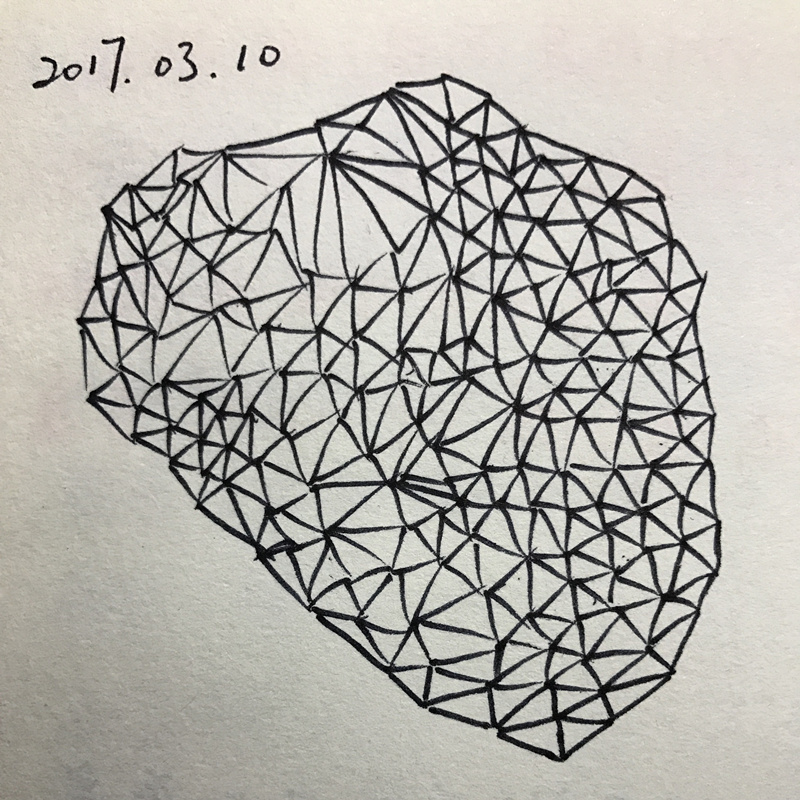
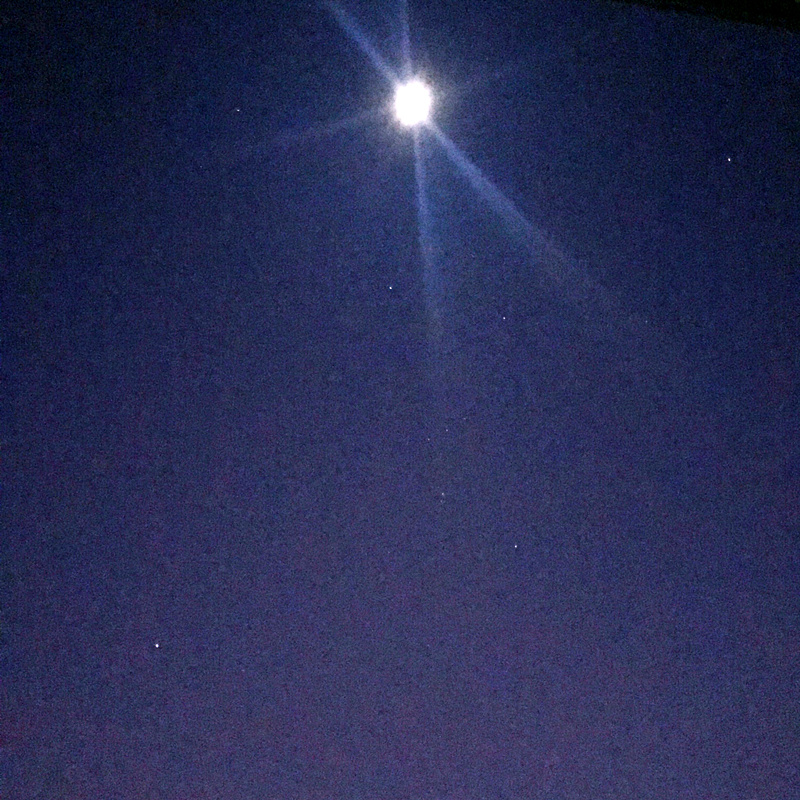
We can see the vague image of Orion right below the Moon and Alhena top left, Aldebaran top right, Sirius left bottom. I’ve not been looking at the stars for a long time! I can not even remember when was the last time I do that.
Orion was the first constellation that I learnt by reading a book telling stories and myths about the stars for kids. I was attracted by Orion because of the myth that how he became one of the constellations.
One myth recounts Gaia’s rage at Orion, who dared to say that he would kill every animal on the planet. The angry goddess tried to dispatch Orion with a scorpion. This is given as the reason that the constellations of Scorpius and Orion are never in the sky at the same time. However, Ophiuchus, the Serpent Bearer, revived Orion with an antidote. This is said to be the reason that the constellation of Ophiuchus stands midway between the Scorpion and the Hunter in the sky.
Another interesting thing is that the pyramids in Giza reflect the belt of Orion. I shared these stories with my classmates in senior school when I was giving a speech to the whole class. I think another reason that I like Orion is that I was born in winter and Orion has the brightest stars in winter.
TITLE: Understanding Convolution for Semantic Segmentation
AUTHOR: Panqu Wang, Pengfei Chen, Ye Yuan, Ding Liu, Zehua Huang, Xiaodi Hou, Garrison Cottrell
ASSOCIATION: UC San Diego, CMU, UIUC, TuSimpl
FROM: arXiv:1702.08502
DUC is illustrated as the following figure.
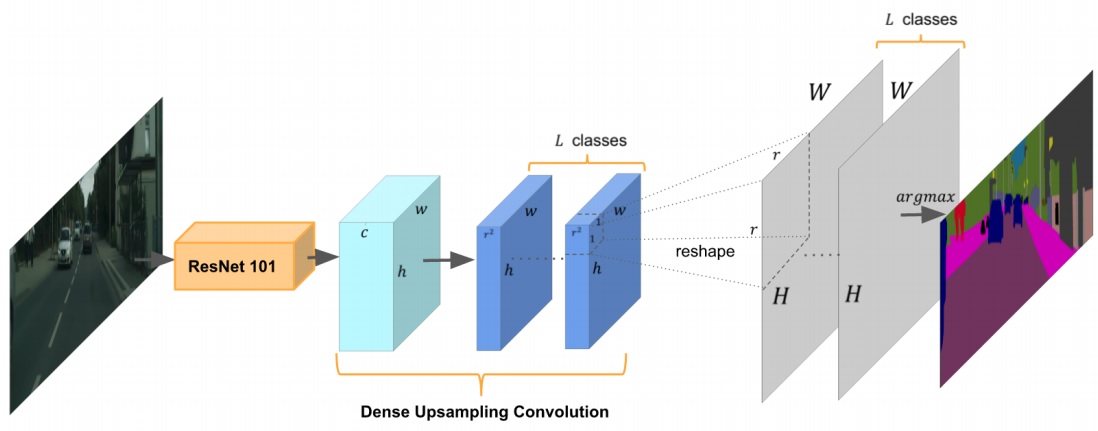
The key idea of DUC is to divide the whole label map into equal subparts which have the same height and width as the incoming feature map. Every feature map in the dark blue part is a corner or a part of the whole output.
HDC is illustrated as the following figure.
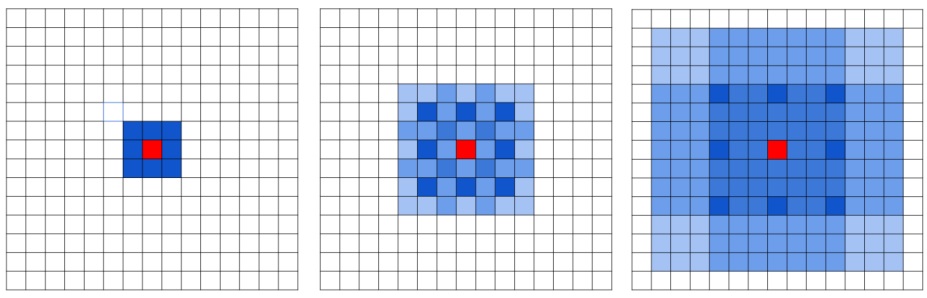
Instead of using the same dilation rate for all layers after the downsampling occurs, a different dilation rate for each layer is used. The pixels (marked in blue) contributes to the calculation of the center pixel (marked in red) through three convolution layers with kernel size 3 × 3. Subsequent convolutional layers have dilation rates of r = 1, 2, 3, respectively.